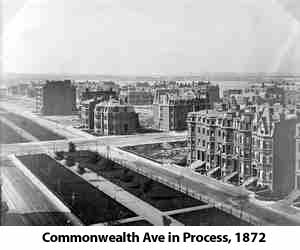
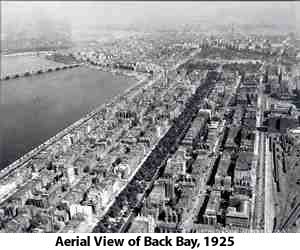
Back Bay Condos
Back Bay Boston Condos - The Back Bay
Boston's Back Bay was at one time a stagnant pool of water west of the Public Garden, but now, is one of the premier places to call home in Boston. Both a commercial (upscale shops and restaurants) and residential district, the Back Bay offers a big city feel that melts into tree-lined quiet residential streets as you move towards the Charles River, which forms the northern border of the historic Boston neighborhood.
Back Bay History
The History of The Back Bay, Boston
| 1814 | Development begins: Massachusetts legislature chartered the Boston and Roxbury Mill Corporation, and approved construction of a long mill dam to cut off 430 acres of tidal flats from the river, which also served as a toll road to Watertown. The dam is under present-day Beacon Street. | |
| 1821 | Basin subdivided into Upper or Fill Basin, Lower or Receiving Basin, to power water mills | |
| 1828 | 70-75 Beacon Street built along the mill dam, oldest structures in the Back Bay | |
| 1841 | US Harbor Commission established line beyond which the Back Bay could not be filled, and thus encroach on the harbor | |
| 1849 | Health Department demanded the area be filled | |
| 1850 | 152 Beacon Street built for Isabella Stewart by her father | |
| 1850 | Massachusetts appointed commission to investigate the Back Bay and recommend development options | |
| 1852 | July -- Commission on Harbor and Back Bay Lands appointed | |
| 1853 | Commissioners on Boston Harbor and Back Bay Lands begin writing annual reports | |
| 1855 | Name of Commission on Harbor and Back Bay Lands changed to Commissioners on Public Lands | |
| 1856 | Tripartite Agreement of 1856 between the State of Mass, Boston, and the Boston and Roxbury Mill Corporation-dividing up the lands. Part of the city land went to develop the Public Garden. | |
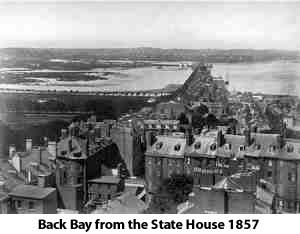
| 1857 | September - Filling of the Back Bay began-average depth of
fill 20 feet; more than 450 acres filled; fill brought from Needham;
streets were filled to grade 17 (17 ft above mean low tide), lots
filled to grade 12, so basements would be below street level.
|
|
| 1859 | Arlington Street Church built | |
| 1860 | The house at 137 Beacon Street,later known as the Gibson House, was built | |
| 1860 | Filling of Back Bay reached Clarendon Street | |
| 1861 | State granted a block of Back Bay (Boylston and Berkeley) to the Boston Society of Natural History and MIT | |
| 1861 | Halcyon Place (corner of Berkeley and Commonwealth) built as a guest home for families of patients at Mass General | |
| 1862 | 152 Beacon Street-Isabella Stewart Gardner moved in | |
| 1862 | Emmanuel Church completed (Newbury Street) | |
| 1863 | MIT located on Boylston-current site of New England Life building | |
| 1864 | Society of Natural History building completed (Berkeley between Boylston and Newbury) | |
| 1865 | December-Toll no longer collected on mill dam toll road | |
| 1865 | First statue erected on the Commonwealth Avenue Mall (also see Mall statues) | |
| 1867 | Central Congregational Church completed (Newbury Street and Berkeley) | |
| 1868 | First Church of 1630 (Unitarian) moved from Chauncey Place to newly completed church designed by Ware and Van Brunt (Berkeley and Marlborough) | |
| 1869 | Temporary coliseum built in Copley Square. It held the National Peace Jubilee that year, which was attended by President Ulysses Grant | |
| 1870 | Filling of Back Bay reached Exeter Street | |
| 1871 | 160 Commonwealth, Hotel Vendome, built-first hotel in city with electric lighting, it had an independent lighting plant designed by Edison in 1882 | |
| 1871 | Brattle Square Church (Unitarian) moved to newly built church designed by H.H. Richardson (Commonwealth and Clarendon) aka-"church of the holy bean blowers." Statues on the tower designed by Frederic August Bartholdi, designer of the Statue of Liberty. | |
| 1872 |
Fire destroys 65 acres of downtown Boston
|
|
| 1874 | Second Church of 1660 (Unitarian) moved from Bedford Street to newly completed church (Boylston between Dartmouth and Clarendon) | |
| 1875 | Third Church (Congregational) moved from Old South Meeting Hall to newly completed church (Dartmouth and Boylston) | |
| 1876 | Museum of Fine Arts opened in Copley Square | |
| 1877 | Trinity Church completed, designed by H.H. Richardson | |
| 1879 | Commissioners on Public Lands changed to Harbor and Land Commission | |
| 1880 | 150 Beacon Street-Isabella Stewart Gardner bought to expand her home at 152 | |
| 1880 | Land for the current site of Boston Public Library purchased | |
| 1882 | Filling of Back Bay complete to Charlesgate East | |
| 1883 | Harvard Medical School located in building at Boylston and Exeter | |
| 1883 | Triangle lot bounded by Huntington, Dartmouth, Boylston purchased and named Copley Square | |
| 1884 | Hollis Street Church completed (southeast corner of Newbury and Exeter, current site of Exeter towers) It was destroyed in 1966 | |
| 1884 | Triangle lot bounded by Huntington, Trinity Place, St. James added to Copley Square to make it a square | |
| 1885 | Temple of the Working Union of Progressive Spiritualists completed (northeast corner of Newbury and Exeter) | |
| 1887 | Bridge from West Chester park in Boston to Mass Ave in Cambridge authorized | |
| 1889 | Bay State Road created by dredging the river and filling the Charles Rivers | |
| 1890 | Filling of Back Bay reached Kenmore Square | |
| 1891 | Bridge from West Chester Park in Boston to Mass Ave in Cambridge opened to travel, and renamed the John Harvard bridge | |
| 1894 | West Chester Park renamed Massachusetts Avenue | |
| 1895 | Boston Public Library opened in Copley Square | |
| 1895 | Christian Science Church dedicated | |
| 1899 | Mass Historical society moved from 30 Tremont Street to the newly built 1154 Boylston Street | |
| 1900 | Filling of Back Bay completed with last few acres of the Fens | |
| 1904 | 5 Commonwealth Ave built by Walter C. Baylies; 1912 built ballroom for daughter's debut. Building now houses the Boston Center for Adult Education. | |
| 1910 | MIT moved from the Back Bay to the north side of the Charles River in Cambridge
|
|